by Karen Atkinson, Director of Mentor Training
Who are the teachers leading our children today? What do they need in order to receive today’s young people with reverence, educate them with love, and lead them into their futures in a way that leaves them free?
We need dedicated teachers who offer joyful, inspiring experiences that set children on a lifelong path of self-education. We also need teachers who can guide young people toward a future that is not yet clearly defined. This is no small task, and it calls for teachers who are well supported in carrying it.
Who Is Standing Before Our Classes?
Our research for the Mentor Training Program suggests that in many Waldorf schools today, more than half of the teachers have not yet engaged in formal Waldorf teacher training. Yet each of them has felt called toward this path. Some find their way to a Waldorf school after becoming disenchanted with conventional approaches to education. Others arrive without prior teaching experience or credentials, simply the right person at the right time, ready to serve, support, love, and educate a class of children.
These warm-hearted colleagues are courageous, to say the least. Still, anyone who stands before a class needs formal preparation and ongoing support, a path that traditionally moves through foundation studies, teacher preparation, and then a lifetime of ongoing renewal.
This reality is not cause for alarm. It is a call to action.
Support Comes in Many Forms
In Waldorf education we have tended to call most forms of support for a teacher “mentoring.” Yet each teacher is an individual on their own path of learning and development, and support can take many forms.
A teacher newly graduated from a Waldorf teacher education program needs a pedagogical partner. A teacher who has not yet had formal Waldorf training needs a seasoned pedagogical guide who can offer clear direction and practical guidance in the classroom. Every teacher benefits from a thoughtful professional development pathway and rhythmical evaluation that treats growth as an ongoing cycle of observation, reflection, and renewal. And every teacher needs pedagogical inspiration: the chance to renew enthusiasm through shared study, the arts, and the exchange of insight.
These forms of support are related, but they are not interchangeable. Mentoring, coaching, evaluation, and pedagogical inspiration each serve a distinct purpose. When schools understand how these forms of support work together, they can create a more intentional and sustainable culture of professional development.
What today’s mentors cannot do is simply say, “I did it this way, so you should do it this way too.” Today’s teachers need support that is fresh, grounded in the pedagogy, and responsive to the world our children are actually growing up in.
Why Experience Alone Is Not Enough
Being a skilled classroom teacher does not automatically make someone a skilled mentor. Mentoring asks for its own capacities: listening without rushing toward advice, observing without judgment, asking a question rather than offering an answer, and knowing when to guide and when simply to accompany a colleague through a hard season.
The Mentor Training Program asks participants to hold their own experience as one valuable source among many, while staying curious about the generative principles of Waldorf education that allow it to keep renewing itself.
The educational landscape has also changed greatly over the past decades. Children arrive with more complex learning profiles, the cultural and technological world around them moves quickly, and the demands of faculty and community life are considerable. A mentor who leans only on memory risks offering yesterday’s answers to today’s questions. When we understand the why behind the pedagogy, we can help a teacher find a living how for the children actually in front of them.
It Begins with Self-Awareness
All of this begins with self-awareness and a willingness to develop new capacities. To be able to educate children, one must first be able to see oneself. The Mentor Training Program emphasizes self-development, fostering relationships, heightened communication skills, and inclusivity. A mentor’s first work is inner work. We cannot guide another person deeper into self-reflection than we are willing to go ourselves.
The program prepares experienced Waldorf educators to serve as pedagogical mentors, on-the-ground coaches, and professional evaluators, both within their own schools and for the wider network of schools seeking support for their new and developing teachers.
The program emerged from a collaborative research project informed by more than one hundred interviews. One of its central aims is to clarify the distinctions between mentoring, coaching, evaluation, and pedagogical inspiration, while taking into account the real financial and human-resource challenges our schools face.
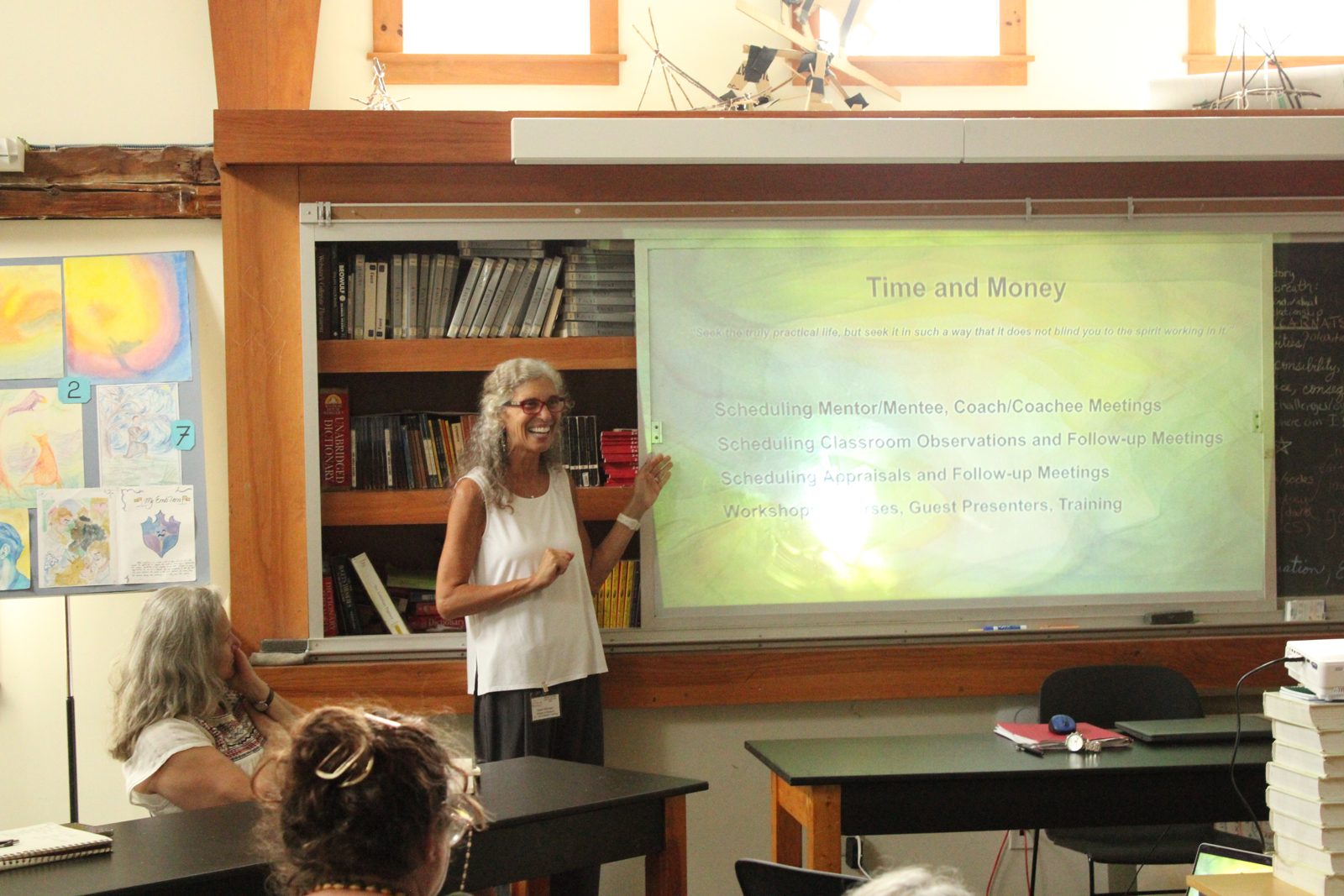
Over ten months, participants meet monthly on Saturdays with program faculty and gather for a week-long, in-person summer residency. The work spans all realms of Waldorf education: early childhood, grades, high school, special subjects, and pedagogical leadership.
Along the way, participants develop practical capacities they can bring directly into their schools: observing classroom practice with greater discernment, conducting reflective mentoring conversations, offering constructive feedback, recognizing the needs of individual teachers, and helping establish thoughtful professional development pathways.
A Living Approach
What I treasure most about this work is that it does not treat mentoring as a set of techniques or checklists. It approaches mentoring as a living art. Our year together moves through the lens of the Seven Life Processes in relation to professional development, from perceiving and warming, through digesting and integrating, toward the generation of something new.
This picture works on three levels at once. It describes the mentor’s own inner development, the steady practice that becomes the anchor of every mentoring relationship. It informs practical skills: how to observe a classroom, how to digest what was seen, how to shape a helpful question, and how to pace feedback so that it nourishes rather than overwhelms. And it illuminates the teacher’s own journey, helping a mentor recognize whether a colleague most needs warmth and encouragement, help in sorting priorities, or space for creative renewal.
Each session is accompanied by artistic work, so that what we learn is not only understood but lived.
Learning to See
Participants gain practical strategies for observation, learning to set aside judgment and preconception in favor of careful seeing. The discipline begins with simply noticing what is in front of us, before rushing toward explanation or conclusion. This quality of attention becomes the foundation for everything else a mentor does.
Mentors carry this same quality of attention into their work with teachers. They observe a lesson not to judge it but to understand it, and they help the teacher see their own classroom with fresh eyes. A mentor is, in this sense, a researcher of sorts, someone who studies a colleague’s practice from the inside and offers insight that is useful because it is truly seen.
This matters most in the hardest conversations, whether about burnout, conflict, uncertainty, or a difficult situation. When a mentor can say “here is what I saw” rather than “here is what is wrong,” a teacher can stay open. When the mentor understands a struggle as a threshold on a lifelong biographical path, the teacher can hear that it is a threshold and not an ending, and can believe it, because the mentor believes it too.
Throughout the program, participants practice these conversations together, so that when such moments arise in their own schools, they are not meeting them for the first time.
What Changes
The most profound shift I have witnessed over the course of several cohorts is a quiet one. Many participants arrive carrying the weight of supporting colleagues in an informal, reactive way, offering advice in hallways and at the end of long days. Over the months, something settles in them. They begin to see the teacher and the classroom as they actually are, free of nostalgia or inherited assumptions.
Then they return to their schools and build something lasting: professional development pathways in which mentoring, coaching, and evaluation each have their place, so that good support no longer depends on one experienced individual.
Our graduates describe this shift in their own words. One wrote that the monthly meetings and pedagogy were essential, and that she left “feeling more knowledgeable, confident, and able to guide with encouragement rather than direction.” Another said the program had given her “clarity and confidence” in her role as pedagogical director.
The teachers they support feel seen and met where they are, and a school that once experienced mentoring as an anxious hurdle begins to experience it as collaborative inquiry and renewal.
When teachers feel seen, accompanied, and able to grow within a school community, mentoring can contribute not only to individual development but also to a stronger sense of belonging and a greater possibility for teachers to remain and flourish. In this way, mentoring supports both the individual teacher and the long-term health of the school community.
Is This for You?
Many kinds of colleagues thrive in this program, but two groups in particular tend to find it especially transformative.
The first are seasoned Waldorf educators and pedagogical leaders, people already carrying the responsibility of mentoring and guiding colleagues within their schools. For this group, the program often offers something they haven’t had before: a structured framework for skills they’ve been practicing intuitively for years, along with a shared language for naming what they do.
The second group are retired educators who still carry real energy and a genuine wish to give back. For them, the program becomes a bridge, a way to stay connected to the work they love while learning how much teaching, students, and schools have changed, so that what they offer comes from relevance rather than nostalgia.
If you are wondering whether the Mentor Training Program is for you, ask yourself two questions. Do you care about the future of Waldorf education beyond your own classroom or school? And are you willing to hold your own experience with humility, staying open to new approaches even after years in the field?
If so, I believe this cohort will give you what makes the commitment worthwhile: not only a certificate, but a genuine expansion of your capacity to guide others well, alongside a community of colleagues walking the same path.
Our community has reached far and wide. One cohort alone brought together forty educators from the United States, Canada, Mexico, Cambodia, and India.
Why This Work Matters Now
Finding and keeping good teachers is one of the most pressing challenges Waldorf schools face today. New educators often arrive with real goodwill, only to meet classrooms shaped by more complex learning profiles, a changed cultural landscape, and the steady demands of faculty life. Left to figure it out alone, even a devoted teacher can slide into exhaustion.
Strong mentoring meets this directly, not by treating Waldorf pedagogy as a fixed inheritance, but by helping a teacher understand the living principles behind the practice well enough to adapt it to the children actually in front of them.
Recruitment is only the beginning. Teachers also need an environment in which they can continue to learn, find their bearings, and feel supported as members of a professional community. Thoughtful mentoring can help schools move beyond isolated acts of assistance toward a more sustained culture of professional growth, belonging, and renewal.
This is, in part, why the program asks so much of a mentor’s own inner life. Warmth is what brings a mentor into a real relationship with a struggling colleague, and rhythm is what sustains both of them through the pace of the school year. A teacher’s own biography, with its particular gifts and vulnerabilities, is not a complication to work around but the very ground from which growth becomes possible.
A mentor who has done this inner work can give a colleague the simplest and most powerful gift there is: space, offered without judgment, in which a person can rise up and become more fully themselves.
What I Hope Participants Carry Home
Above all, I hope participants leave with a renewed sense of purpose, not only new skills, but a deeper conviction that mentoring is one of the most meaningful ways to serve the future of our movement.
Wisdom that stays inside one person’s experience, however rich, eventually fades. Wisdom that is cultivated and consciously passed on becomes something living, something that continues to grow long after any of us has left the room.
I often think of the lighthouse as an image for this work. A lighthouse does not steer the ship or take the wheel. It stands steady, keeps its light burning through every kind of weather, and helps others find their own way safely home. In the same way, a mentor offers a steady presence, patient and warm, so that a colleague can steer their own course with growing confidence, season after season.
This is why I think of the Mentor Training Program as more than professional training. It is also a path of spiritual growth, inviting educators to live their wisdom in service to others through an act grounded in humility, care, and responsibility.
Participants often tell us this themselves. One graduate wrote that the program had given her “a telescope that examines through the past, stands solidly in the present and reaches toward the future of what it means to be an authentic mentor.” Another called it simply “the medicine needed for our times.”
We invite experienced Waldorf educators who feel this calling to join the Mentor Training Program. If you are ready to place your experience in service of the next generation of teachers, and to deepen your capacity to guide, accompany, and inspire colleagues, we would be glad to welcome you into this work.
Learn more about the Mentor Training Program here, or contact Karen Atkinson, Director of Mentor Training, at karen@centerforanthroposophy.org.