SPRING 2026
In This Edition...
KARMIC RECONCILIATION: CLEARING A PATH FOR DESTINY by Torin Finser
Review by Bev Boyer
Towards the end of his life Rudolf Steiner took up a monumental task: to present a clearer knowledge of reincarnation and karma. In 1924 he gave over eighty lectures on the topic. This body of work, critical to a thorough understanding of anthroposophy, can sometimes seem daunting, even to the sincere student.
In this light, Torin Finser’s most recent book, Karmic Reconciliation: Clearing a Path for Destiny, is to be warmly welcomed. The author points out that this work is the culmination of decades of personal study and reflection. As a result, the reader can readily sense the depth of insight and maturity of understanding that is brought to this material.
Finser presents Steiner’s teachings in a highly approachable format. The book is, in fact, a study guide, organized into fifty-two short units. In addition to offering clear summaries of Steiner’s teachings, Finser invites the reader to actively engage with the content through a series of assignments. These may take the form of responses to questions through journaling, quiet contemplation, or group discussion. Quite often these reflective questions involve relating the content to present-day issues, giving a sense of relevance and immediacy to the material.
Far from presenting karma as a simplistic system of rewards or punishments, Steiner describes it as a feedback loop, shaped by intention, choice, and awareness, and operating both personally and collectively. The reader comes to understand the great cycle of death and rebirth: After death we revisit the events of our most recent earthly life, but we feel them through the “eyes” of those who experienced our actions. In facing this “cosmic mirror”, powerful intentions arise for us to return to earth and compensate for past actions. Thus, we enter our next earth life with a deep desire to seek out life situations that will allow us to rebalance circumstances created in the past. These intentions and desires are generally hidden from our conscious mind, but their effects are felt throughout our lives. The conscious study of karma can help bring an awareness to these subtle forces. As the author points out, “The study of karma can help us identify our intentions, work with them, and bring new guidance to future human encounters” (page xiv).
One of the themes highlighted in the book is the degree to which we are all knit together through karma. In fact, in an essay titled “Karmic Leadership”, included as an appendix, Finser makes the case that Waldorf schools are often karmic communities. They are chock full of opportunities to transform karmic obligations that we bring with us from the past, to wisely facilitate karmic encounters, and thus to attain a freedom that will allow us to “move more readily beyond the boundaries of our personal self and allow liberated soul forces to flow into the social life” (page 207). In this way the path to our true destiny is cleared.
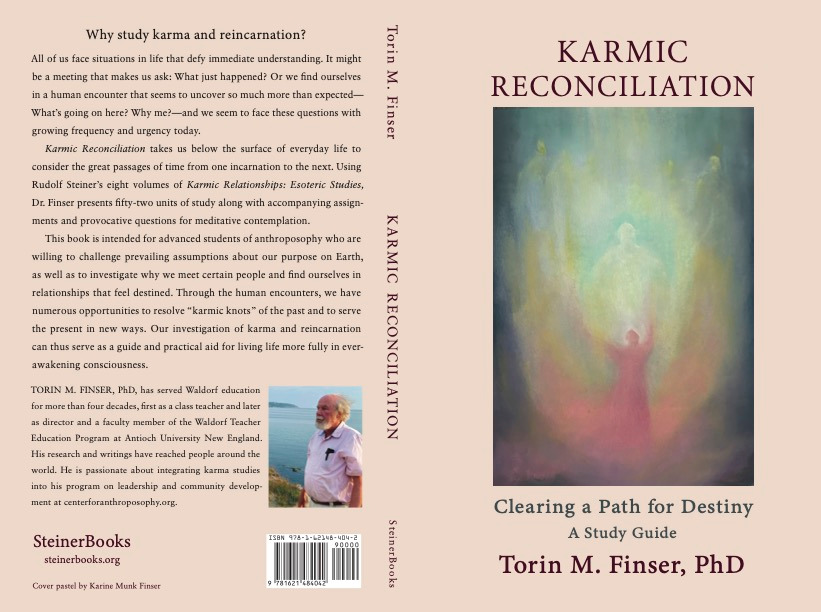
Karmic Reconciliation: Clearing a Path for Destiny makes a strong case for opening our eyes to the laws of the universe as presented in Steiner’s karma lectures. The reader comes away with a feeling of empowerment, filled with the realization that by illuminating strands from the past, “we can lift our level of interaction with others from reactive behaviors to more enlightened, mindful, and heart-centered responses” (page xvii).
Bev Boyer: A graduate of the AUNE Waldorf Teacher Education program, Bev divided her 25-years in the classroom between The Waldorf School of Princeton and High Mowing School. Following that, she was thrilled to work at the Center for Anthroposophy as the Director of their Explorations Online program. Now, in “retirement” she finds herself as busy as ever.
Spring/Summer 2022