Home » News
News
Here you’ll find the most recent news from CfA, plus the insights and reflections on the state of Waldorf education in the context of world developments.
CfA’s free online newsletter Center & Periphery, published three times a year, includes original feature articles of general pedagogical interest as well as updates on the Center’s six part-time programs.
Wilton, New Hampshire, July 7-12 In today’s world, we are constantly bearing witness to global crises and tragedies, and therefore, we live in a world that is rife with untreated trauma. How do we create a culture that is inclusive of this task, given to all human beings? A culture where everyone matters, and where human encounter is the ultimate creative invitation to harness our capacities of presence? We need tools to achieve deeper levels of understanding and to put our knowledge into action. I have found much to learn from the worldwide crisis intervention leader, Bernd Ruf. He is the founder of the Parzival Center, a school of 750 children from infancy to age 24, where everyone is accepted, no matter how difficult the task, and how deep the suffering. Bernd is also the co-founder of the Emergency Pedagogy Center in Karlsruhe, Germany. Since 2006, trained therapists, teachers, and trained emergency pedagogy volunteers have reached out to countless places all over the world to help children and young people experiencing trauma from war or natural catastrophes. Why Emergency Pedagogy? 1. Because we want to help those in need: Traumatized children are in the most dangerous position as their trauma can hinder their development and prevent their lives from reaching their full potential. Every human being who is prevented from bringing their capabilities to this earth is a loss for all of us. “The human being who saves a person saves the world.“2. Because we are all connected to this earth we need our collective consciousness and our collective efforts: Only in human encounters can we make a difference. The earth depends on us becoming well-grounded so we can do what we came here to do. Our work is all about helping the children incarnate despite trauma. Bernd tells of a woman who watched the team work with children. Every day she arrived from early morning to late evening, always sitting on the spot where dark stains tainted the wall behind her. On the last day, she stood up and said, “My child was shot here, in the head and in the heart. She added, “You don’t only heal the children, you heal the earth.” There is no human being without the earth, and there is no earth without the human being. 3. Because we live in a time where we need to understand that spiritual health is physical health and that we are in a battle against the materialistic forces that aim to dehumanize us. What happens when we experience trauma? Through shock, the I excarnate, and you can say that the I is imprisoned, unable to fully incarnate. Where the I should reside, there is a wound, and if not attended, can create a vacuum, making the person vulnerable and less able to find meaningfulness in their lives. This affects health as well. We have a unique opportunity to meet Bernd Ruf, listen to daily morning lectures, and attend afternoon trauma-preventative therapy sessions before a Q&A session with Bernd at the end of the day. Getting to sit in a circle with Bernd and to ask questions in such an intimate setting is such a memorable experience. Please consider joining this unique opportunity. We still have some housing, please visit our website at centerforanthroposophy.org/kairos-instituteand register. There’s lot more information there as well about Emergency Pedagogy and our courses. With warmest wishes, Karine Munk Finser, Director, Kairos Institute, Training in Artistic Therapies, Training in Emergency Pedagogy karine@centerforanthroposophy.org
Read the Winter 2024 issue of Center & Periphery, CfA’s newsletter, for feature articles, program news, and updates from the Center for Anthroposophy.
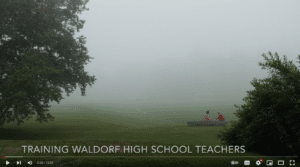
High school teachers specializing in science and math are especially helped by a training saturated in the arts––especially the performing arts––as this new video of CfA’s Waldorf High School Teacher Education Program (WHiSTEP)  so aptly illustrates. Watch the video below.
With this issue, we kick off what we hope will become a regular feature of our thrice-yearly publication––namely, interviews with our alumni describing their life’s journey as Waldorf early childhood, elementary, high school, and subject teachers. What––or, more likely, who––drew them to Waldorf education, and how did they find their way? Continue reading…
High School Seminar Week More than 20 Waldorf teachers and student teachers attended a high school seminar this week at RSCC with visiting teacher David Barham. When he’s not traveling around giving courses, David leads the high school program at Centre for Anthroposophy in Wilton NH, having taken over the leadership of that program from Douglas Gerwin. In addition to the full time RSCC teacher education students, this week was attended by teachers from several Ontario Waldorf schools including Toronto Waldorf School, Trillium Waldorf School and Halton Waldorf School. The lead photo shows most of the folks who attended the week, though the TWS teachers were not there when the picture was taken. While mornings were devoted to classroom sessions at RSCC — a blend of lectures, and small group work, with the opportunity to present skits on various facets of adolescence and the life of high school students, afternoons (for the guest teachers from other schools) were given over to observation in real-life classes in the high school of the Toronto Waldorf School. Last week David was also here at RSCC as part of a group from AWSNA who were here to confirm RSCC’s full member institute for Waldorf teacher education. First photo below is David Barham teaching, next three are of students working in small groups, and the last one is of a blackboard full of class-generated observations about grade nine students. David Barham, teaching at RSCC this past Tuesday October 24th Teacher David Barham looks on as students work in small groups The high-school-week group included both full-time RSCC teacher education students and teachers from local schools. Working together in small groups Students helped fill a blackboard describing common traits of ninth graders on Monday October 23rd.
Journeying often serves as a metaphor both for mapping out a course of education as well as charting a path towards healing. In this spring issue of our newsletter Center & Periphery, we offer several iterations of this image. Continue reading…
Sign up to receive our Center & Periphery Newsletter!
You’ll receive the newsletter via email quarterly.